



Eyelid surgery (blepharoplasty)
About the procedure
Eyelid surgery (blepharoplasty) is a surgical procedure aimed at improving the appearance of the upper and/or lower eyelids and reducing associated functional problems. With age, the skin around the eyes loses elasticity, which may lead to drooping eyelids and the formation of skin folds. For many people, this means not only aesthetic changes but also a restricted field of vision and a feeling of eye fatigue.
Depending on the patient’s needs, I perform upper eyelid surgery, lower eyelid surgery, or both procedures simultaneously. Eyelid correction has both an aesthetic and a functional dimension, and may improve visual comfort.
Indications
The need for correction may be indicated by: restricted field of vision, a feeling of heaviness in the eyelids, chronic eye fatigue, visible wrinkles around the eyes, as well as under-eye bags and swelling that do not subside despite the use of cosmetics.
Indications: upper eyelids
- excess loose skin on the eyelids, causing a tired look or limiting the field of vision,
- drooping eyelids that make it difficult to see,
- herniated orbital fat that add weight to the eyelids and change their shape,
- lack of elasticity and tension in the eyelid skin, leading to loss of definition of the eyelid lines.
Indications: lower eyelids
- excess loose skin on the lower eyelids, causing puffiness or wrinkles,
- fatty bags under the eyes that cause puffiness and change the shape of the eyelids,
- lack of elasticity and tension in the lower eyelid skin, leading to loss of definition of the eyelid lines,
- abnormal lower eyelid tension affecting how the eyelid rests against the eyeball, which may cause abnormal positioning of the eyelashes,
- distortion of the lid-cheek junction caused by the anatomy of the ligaments in this area or by excessive previous aesthetic medicine treatments.
The procedure
Preparation
Depending on the patient’s needs, I plan upper eyelid surgery, lower eyelid surgery, or both procedures simultaneously. If the planned lower eyelid correction is more complex, it is recommended to split the two procedures. Qualification for lower eyelid surgery requires a comprehensive assessment of the eyelids and adjacent structures; based on this, I select the surgical method.
How the procedure is performed
Eyelid surgery can be performed under local or general anaesthesia. The procedure begins with marking the incision lines, which are planned to minimise scar visibility.
Upper eyelids
I perform upper eyelid surgery under local anaesthesia. I make the incision in the eyelid crease. I remove excess skin, fat and/or muscle, and if necessary, remodel the tissues, which allows lifting the eyelid and restoring its natural contour. The procedure lasts approximately 1 hour. Sutures are removed after about 7-8 days.
Lower eyelids
Lower eyelid surgery involves removing excess skin and remodelling fat and/or muscle tissue, which reduces the effect of “bags under the eyes”. Depending on the patient’s anatomy, I use one of two methods:
- transconjunctival method: the incision is made in the conjunctival sac, on the inner surface of the eyelid, so it is not visible on the skin,
- transcutaneous method: the incision is made 2 mm below the lashes and, after healing, looks like a typical expression line; it is indicated for significant laxity of the skin in the eyelid area and can be combined with a midface lift, i.e. lifting the middle third of the face.
If the patient has weakened structures supporting the lower eyelid, I perform canthopexy, i.e. suturing and reinforcing the tarsal plate structures, which form the skeleton of the eyelid. The procedure can be combined with laser therapy of this area and the application of the patient’s own fat (nanofat) to improve the condition of the eyelid skin and fill irregularities. Sutures are removed after about 7-8 days.
Aftercare
Immediately after surgery, mild swelling and bruising may appear, which gradually subside over the course of a few days. Most patients return to their daily activities after about 7-10 days, although full healing may take several weeks.
Post-procedure recommendations:
- apply cold compresses to the eyelids for a few days to reduce swelling and redness,
- avoid strenuous physical activity for about 4 weeks,
- use the recommended analgesic therapy and anti-inflammatory drugs, if I prescribe them,
- protect against direct sunlight and use creams with a high SPF on the treated areas,
- avoid contact lenses and eye make-up for a few days,
- apply an antibiotic ointment into the conjunctival sac for a week.
The result is assessed after a few weeks, once the skin has fully healed. After upper eyelid surgery, patients usually notice a refreshed appearance of the eyelids, a more defined eyelid line, and, if drooping eyelids had limited vision, an expanded field of vision. The aim of lower eyelid surgery is to smooth out wrinkles, reduce puffiness and fatty bags, and diminish the separation between the cheek and the lower eyelid. The result depends on the patient’s individual anatomical features. The effect usually lasts for many years, although the skin ageing process continues.
Before and after results
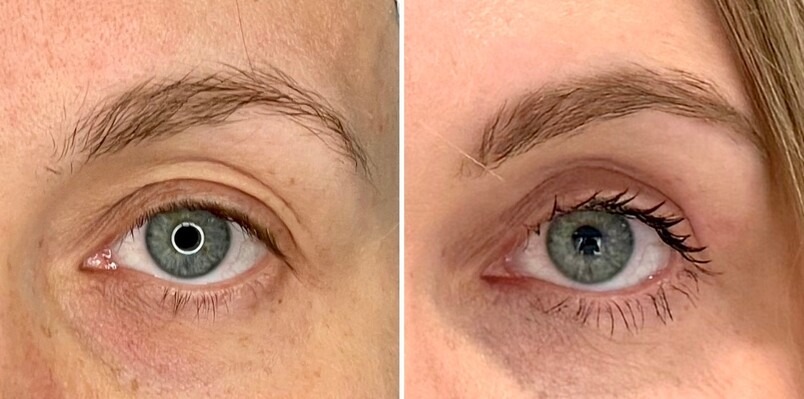
Every case is different and the result of a procedure depends on the individual features of the patient. Photos are published with the written consent of patients or in a form that does not allow them to be identified.
All results →Frequently asked questions
Is eyelid surgery painful?
The procedure is performed under local or general anaesthesia. After surgery, you may experience mild discomfort, which is managed with painkillers.
Are scars after eyelid surgery visible?
Incisions are made in the natural creases: in the upper eyelid crease or just below the lash line. In the transconjunctival method, the incision is made on the inner surface of the eyelid, so it is not visible. After healing, the scars are usually very faint.
When can I return to work after eyelid surgery?
Most patients return to their daily activities after about 7-10 days. Full healing may take several weeks.
Can eyelid surgery improve the field of vision?
Yes, when excess skin on the upper eyelids limits the field of vision, its removal may improve visual comfort.